Note from NASSCO Manual

PACP

  1. Perspective view of the defect and the entire circumference of the surrounding pipe is required when coding a defect or features
  2. There are two main ways that defect can be coded:
    1. Point Defects (use code column)
    2. Continuous Defect (use code and continuous defect column)
      1. Truly Continuous Defect: Defects/observations which run along the pipe for more than one metre or three feet without any interruption
      2. Repeated Continuous Defect: Defects/observations which occur in at least 3 out of 4 joints (75%) along the pipe (not every joint needs to be affected)
  3. Type of Defect Coding:
    1. Structural
      1. if crack, fracture, broken, and hole can be seen at the same location, code the highest severity code (hole)
    2. Operation and Maintenance
    3. Construction feature (do not have risk score)
    4. Miscelleous feature (do not have risk score)
  4. The PACP code is comprised of a combination of a Group, Descriptor and Modifier
    1. Group: a broad categorization of the defect/observation
    2. Descriptor: further defines the defect/observation
    3. Modifier: an extension of the Group/Descriptor Code and provides more detailed information
  5. In appendix D: PACP-BASED risk management
    1. LoF for each defect
    2. CoF

Modify the create image labels script

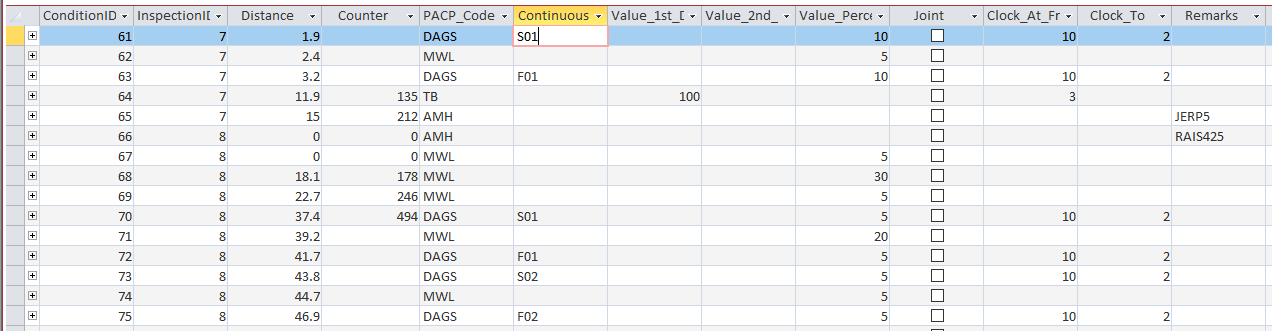
  1. Continuous defect is a defect/observation that run along the pipe for more than one metre or occurs in at least 3 out of 4 joints.
  2. The continous defect is only captured in the Assess database and not with the video footage. By modifying the create image labels code to handle the continuous defect, we will increase the number of Frame with other defect other than ND. example of continous defect The continous defect starts with Sn and end with Fn where N is the number from 01 to 99. For the figure above, we have the deposits attached grease from 1.9m (S01) to 3.2m (F01)